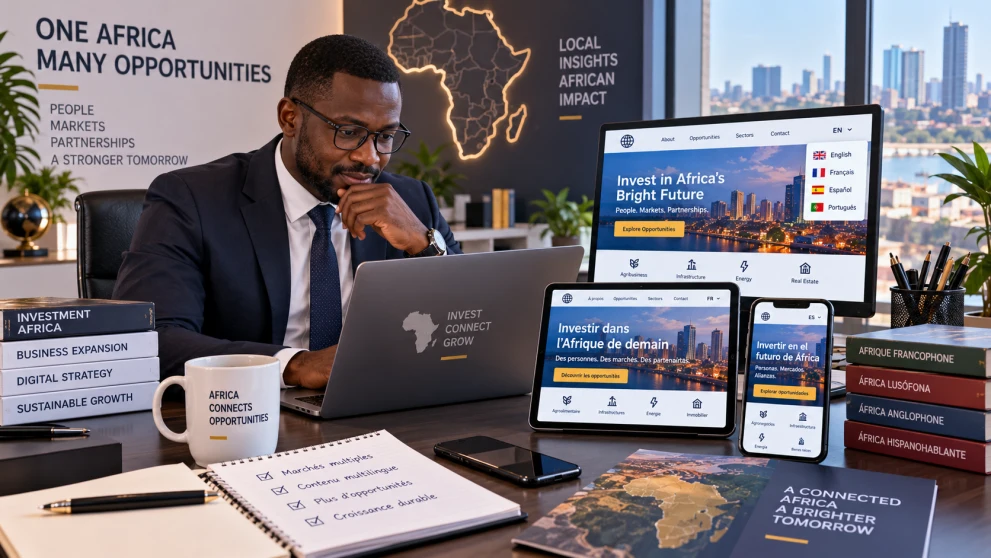
Africa is not a single-language market, yet a large share of investment and advisory content published online is available only in English. That gap means opportunities, and the credibility behind them, often fail to reach French-speaking and Spanish-speaking audiences across the continent and beyond, not because the content is irrelevant to them, but because it is not accessible in their language.
Language is a trust signal, not just a convenience
Investors and partners evaluate credibility partly through how clearly an organisation communicates with them. Content that only exists in English signals, whether intentionally or not, that other markets are secondary. A genuinely pan-African investment office has to communicate in the languages its counterparts actually use, not just the one most convenient to publish in first.
Why we rebuilt our own site around this
This is one of the reasons Knowis Group Investments has invested in a multilingual digital presence across English, French and Spanish, with content structured so that each language version carries the same substance rather than a thin translation of the original. Sector pages, track record and advisory content are maintained per language, not bolted on as an afterthought.
What this means in practice
A multilingual presence is only useful if it stays current in every language, which is why translation is treated as part of the publishing process itself: content is drafted, reviewed and then made available across languages as part of the same workflow, rather than left to lag behind the English version.
For any organisation positioning itself as a pan-African partner, the practical test is simple: can a French-speaking or Spanish-speaking counterpart find the same quality of information, in their own language, as an English-speaking one. If not, the "pan-African" positioning is only partly true.
Translation quality is part of the credibility test
A poorly translated page can do more damage than no translation at all, because it signals that the language version was an afterthought rather than a genuine channel of communication. Automated translation has a role to play in keeping multiple languages current, but sector-specific terms, financial figures and legal wording deserve a human review pass before publication, which is why our own translation workflow keeps every machine-generated version editable and flags anything that has been manually corrected so it is never silently overwritten.
What this looks like for prospective partners
A French-speaking investor researching an opportunity in the region should be able to read our sector pages, our track record and our advisory content with the same depth as an English-speaking one, not a shortened summary. That is the practical standard we hold our own multilingual site to, and it is the standard we would encourage any organisation serious about pan-African partnerships to apply to its own communications.
Language as market coverage, not just accessibility
Seen this way, a multilingual site is less a courtesy than a market coverage decision. Every language a business fails to communicate in is a segment of the pan-African market it is effectively deciding not to compete for, whether or not that decision was made deliberately.