Reliable trade across African borders depends less on any single breakthrough and more on unglamorous infrastructure: enough trucks to move volume, enough fuel access to keep them running, and enough storage capacity to smooth out supply gaps. When one of these elements is missing, the whole supply chain slows down, regardless of how efficient the rest of it is.
Fleet capacity is the first constraint
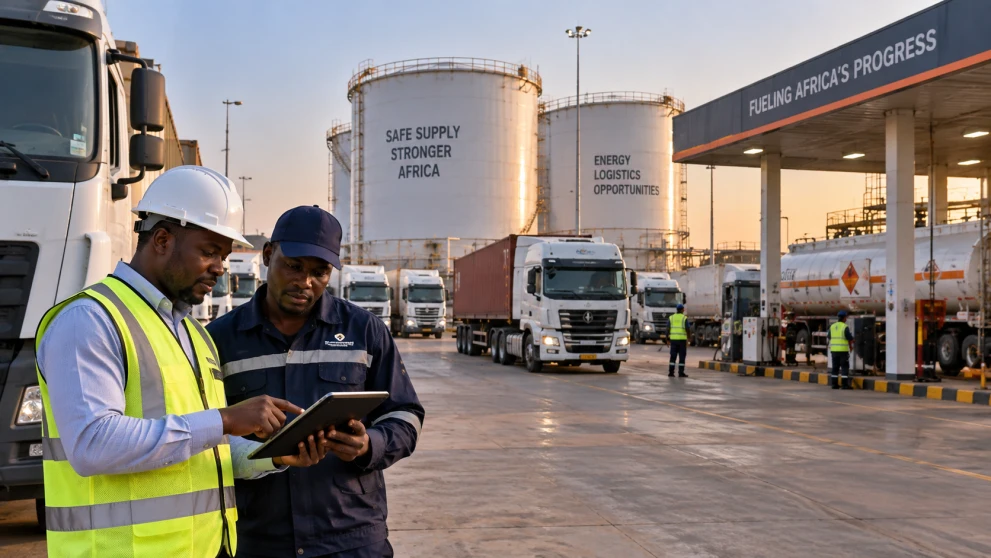
A fleet sale agreement for 100 trucks, concluded as part of our logistics track record, illustrates the scale at which fleet decisions need to be made to meaningfully change a corridor's capacity. Buying vehicles one or two at a time rarely shifts the economics; it is the scale of the acquisition, matched to route and cargo type, that determines whether a fleet investment actually resolves a capacity bottleneck.
Fuel access has to travel with the fleet
Vehicles are only useful if they can refuel reliably along their routes. The deployment of 12 mobile service stations addressed exactly that gap: bringing fuel access to routes and locations where fixed infrastructure was not yet available, rather than waiting for permanent stations to be built.
Storage smooths out the rest
The supply of storage tanks, concluded as part of the same body of work, plays a different but related role: buffering supply so that short-term disruptions upstream do not immediately translate into delivery failures downstream. Storage capacity is often the least visible piece of a logistics chain and the one most likely to be underfunded.
The lesson for investors and operators
None of these three elements works well in isolation. Fleet without fuel access stalls, fuel infrastructure without storage is fragile, and storage without adequate fleet capacity just delays the same bottleneck. Resilient logistics comes from treating fleet, fuel access and storage as one investment decision rather than three separate ones, which is the approach behind the transactions summarised above.
Sequencing the investment matters
One lesson that is easy to miss is that the order in which fleet, fuel access and storage are brought online affects how quickly a corridor sees returns. Adding fleet capacity before fuel access is in place simply idles trucks; adding storage before there is enough fleet volume to justify it ties up capital that could have gone toward vehicles. The transactions summarised here were sequenced deliberately, fleet and fuel infrastructure developed alongside one another, with storage capacity brought in to stabilise supply once volume was established.
What operators should ask before committing capital
For operators and investors evaluating a logistics opportunity, three questions cut through most of the complexity: does the fleet size match the actual freight volume on the route, is fuel access reliable enough to keep utilisation high, and is there enough storage buffer to absorb a short-term supply disruption without stopping deliveries. Projects that can answer all three convincingly are the ones most likely to perform as modelled, and it is exactly this combination that has underpinned our own concluded logistics mandates.
A capability worth building on
Delivering fleet, fuel infrastructure and storage transactions of this scale builds an operational knowledge base that transfers well to future mandates. Every corridor is different, but the underlying discipline, sizing each element against actual freight and demand data rather than assumptions, remains the same wherever it is applied.